The
Beginning of Photography in
Thailand
"Photography
came to Thailand during the reign of
King Rama 3 but, in that time people
still believed that to mold the figure
or take a picture of oneself will
shorten his or her life. No one
interested in this thing until the reign
of King Rama
4..." H.S.H
Princess Poonpismai
Diskul
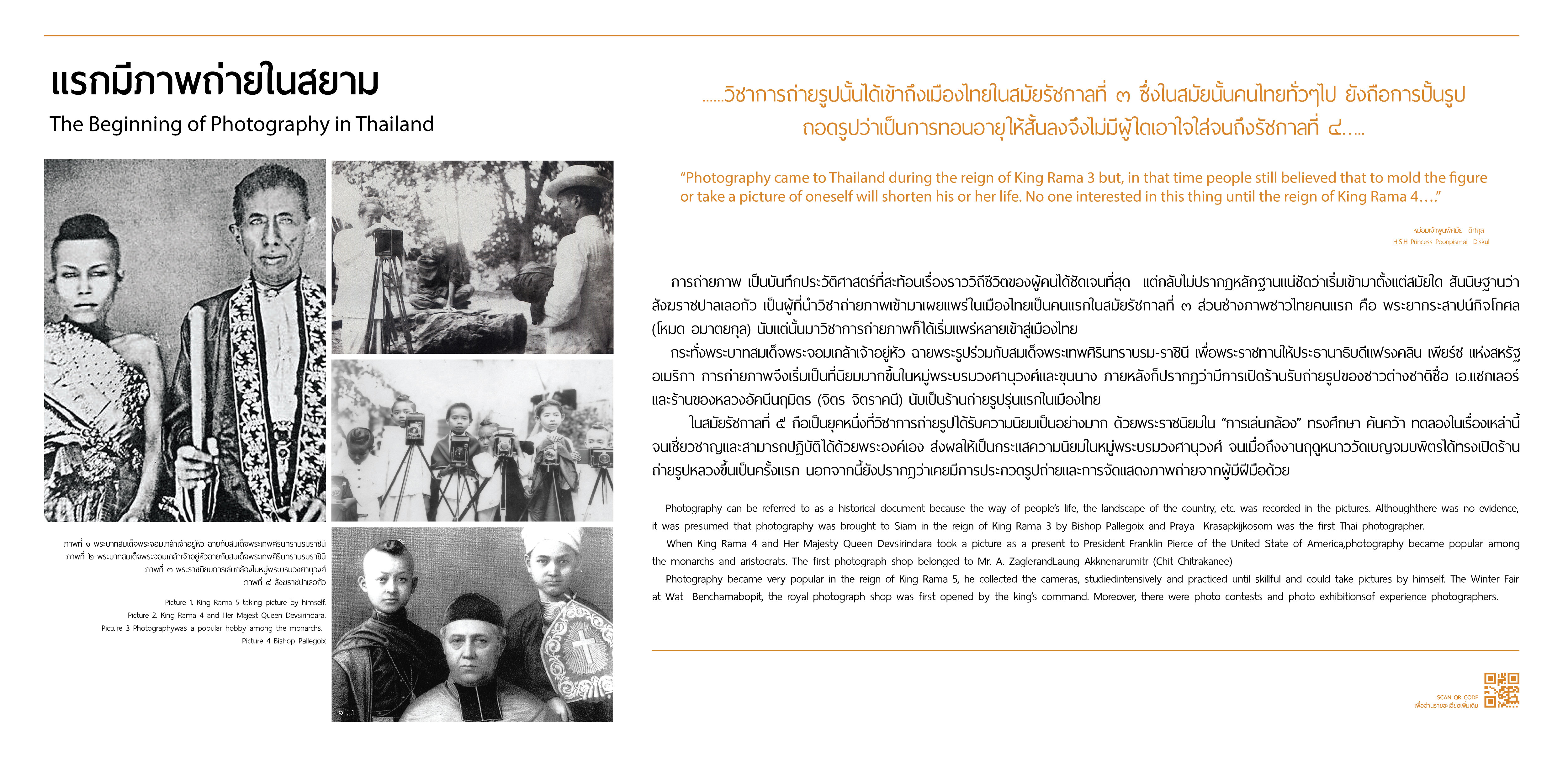
Photography can be
referred to as a historical document
because the way of people's life,
the landscape of the country, etc. was
recorded in the pictures. Althoughthere
was no evidence, it was presumed that
photography was brought to Siam in the
reign of King Rama 3 by Bishop Pallegoix
and Praya Krasapkijkosorn was the first
Thai
photographer.
When King Rama 4
and Her Majesty Queen Devsirindara took
a picture as a present to President
Franklin Pierce of the United State of
America,photography became popular among
the monarchs and aristocrats. The first
photograph shop belonged to Mr. A.
ZaglerandLaung Akknenarumitr (Chit
Chitrakanee)
Photography became
very popular in the reign of King Rama
5, he collected the cameras,
studiedintensively and practiced until
skillful and could take pictures by
himself. The Winter Fair at Wat
Benchamabopit, the royal photograph shop
was first opened by the king's
command. Moreover, there were photo
contests and photo exhibitionsof
experience
photographers. Beautiful
Life “...I had
sent you six cameras, one for you, One
for Ying Klang, one for Ying Noi, one
for Erb, one for Earn and one for
Sadab...” A
letter of King Rama 5 to H.R.H. Krom
Praya
Dumrongrajanuphab
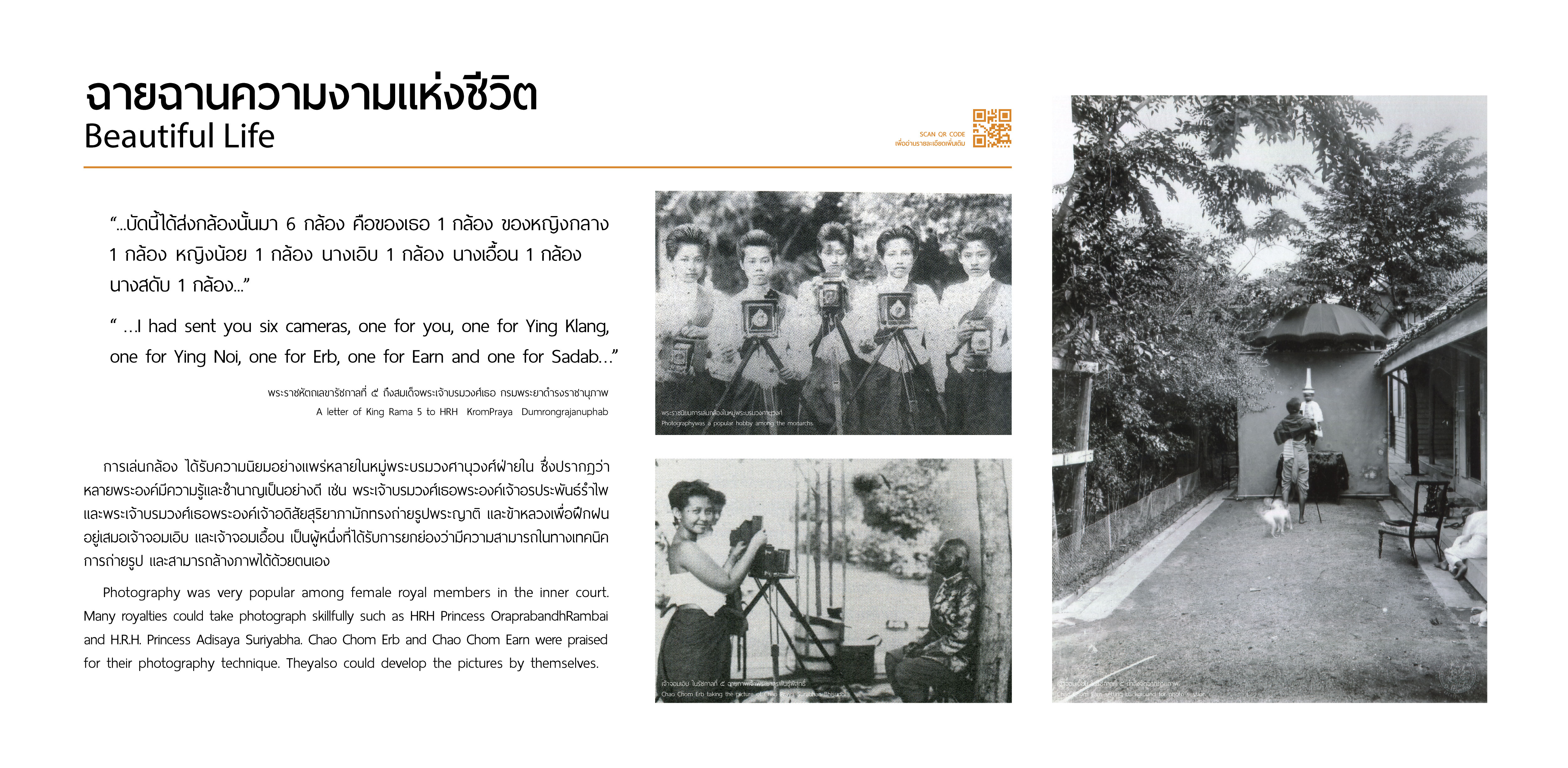
Photography was
very popular among female royal members
in the inner court. Many royalties could
take photograph skillfully such as HRH
Princess OraprabandhRambai and H.R.H.
Princess Adisaya Suriyabha. Chao Chom
Erb and Chao Chom Earn were praised for
their photography technique. Theyalso
could develop the pictures by
themselves. Traditional Pattern of
Clothing
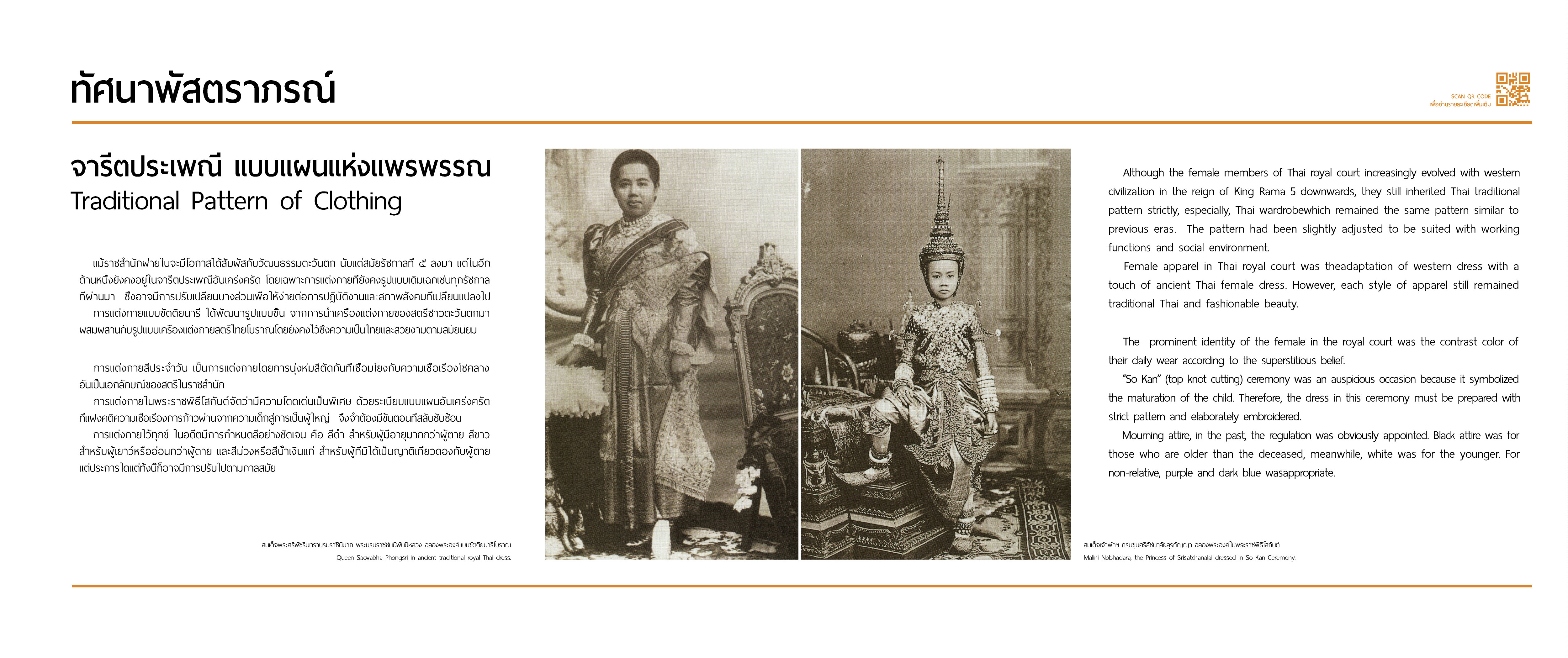
Although the female
members of Thai royal court increasingly
evolved with western civilization in the
reign of King Rama 5 downwards, they
still inherited Thai traditional pattern
strictly, especially, Thai wardrobewhich
remained the same pattern similar to
previous eras. The pattern had been
slightly adjusted to be suited with
working functions and social
environment.
Female apparel in
Thai royal court was theadaptation of
western dress with a touch of ancient
Thai female dress. However, each style
of apparel still remained traditional
Thai and fashionable
beauty.
The prominent
identity of the female in the royal
court was the contrast color of their
daily wear according to the
superstitious
belief.
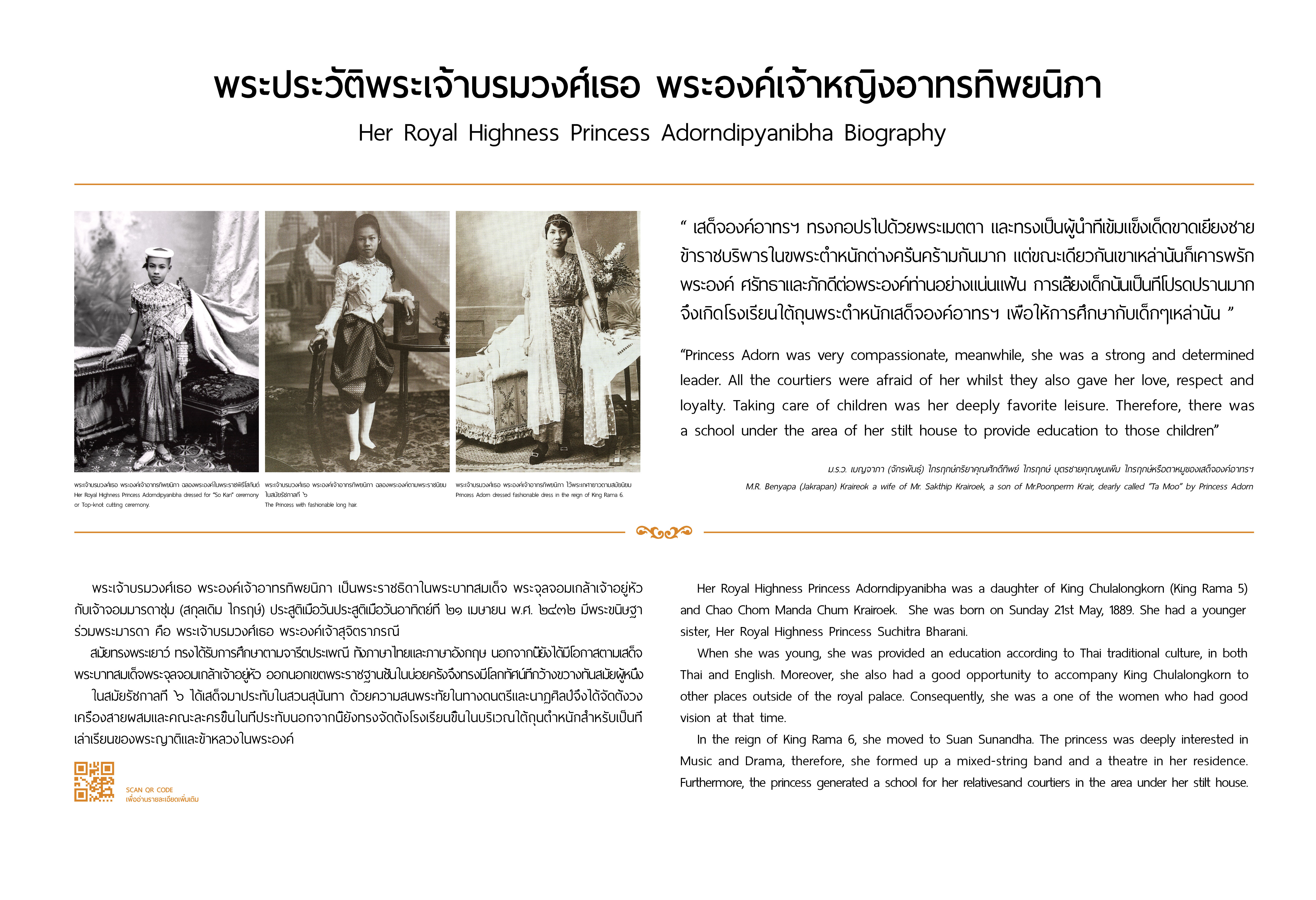
"So Kan”
(top knot cutting) ceremony was an
auspicious occasion because it
symbolized the maturation of the child.
Therefore, the dress in this ceremony
must be prepared with strict pattern and
elaborately
embroidered.
Mourning attire, in
the past, the regulation was obviously
appointed. Black attire was for those
who are older than the deceased,
meanwhile, white was for the younger.
For non-relative, purple and dark blue
wasappropriate. Culture
Wave and
Modernism
Later, the apparel
of female members in the Royal Court had
been widely opened to the western
civilization. The apparel was not only
for auspicious occasions or taking
photos, but also for the use of daily
life. In the reign of King Rama 6, the
popularity of female wear was changed
from Chong Kraben to Pa Sin. Then, in
the reign of King Rama 7, sleeveless
blouse and skirt were popular. That was
a role model for Thai female in that
era.
The
modification of clothing in Thai royal
court reflected the combination of Thai
and western civilization and signified
the roles of Thai female in that era.
Therefore, theselection of dress was an
important factor to demonstrate our
"civilization”.
“...Her
Serene Highness Princess Prompraophanwas
a kind of beauty loving woman. She
normally dressin brocaded loincloth
(Chong Kraben) and printed silk, her
jacket was sewn by a lady from Badman
and Co. Her shoes were
made of leather or colorful satin that
went well with her dresses sewn from
John Sampson department store. They were
as beautiful as footwear from Winter
Mall in
England.” Her Serene
Highness Princess
JongjittanomDisakul Her
Royal Highness Princess Adorndipyanibha
Biography
"Princess
Adorn was very compassionate, meanwhile,
she was a strong and determined leader.
All the courtiers were afraid of her
whilst they also gave her love, respect
and loyalty. Taking care of children was
her deeply favorite leisure. Therefore,
there was a school under the area of her
stilt house to provide education to
those
children” MR.
Benyapa (Jakrapan) Kraireok a wife of
Mr. Sakthip
Krairoek, a
son of Mr.Poonperm Krair, dearly called
"Ta Moo” by Princess
Adorn
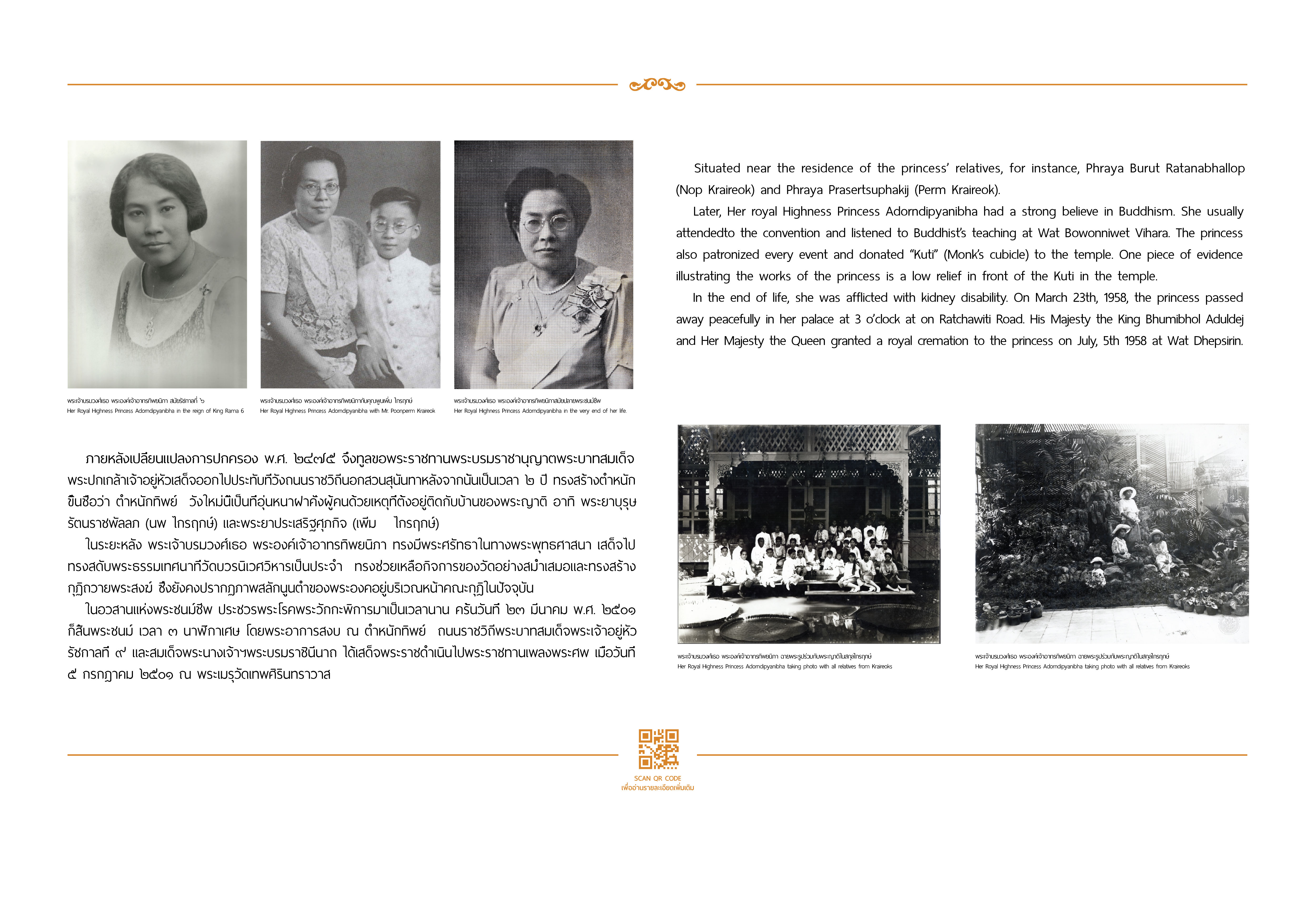
Her Royal Highness
Princess Adorndipyanibha was a daughter
of King Chulalongkorn (King Rama 5) and
Chao Chom Manda Chum Krairoek. She was
born on Sunday 21st May, 1889. She had a
younger sister, Her Royal Highness
Princess Suchitra
Bharani.
When she was young,
she was provided an education according
to Thai traditional culture, in both
Thai and English. Moreover, she also had
a good opportunity to accompany King
Chulalongkorn to other places outside of
the royal palace. Consequently, she was
a one of the women who had good vision
at that time.
In the reign of
King Rama 6, she moved to Suan Sunandha.
The princess was deeply interested in
Music and Drama, therefore, she formed
up a mixed-string band and a theatre in
her residence. Furthermore, the princess
generated a school for her relativesand
courtiers in the area under her stilt
house.
Situated near the
residence of the princess'
relatives, for instance, Phraya Burut
Ratanabhallop (Nop Kraireok) and Phraya
Prasertsuphakij (Perm
Kraireok).
Later, Her royal
Highness Princess Adorndipyanibha had a
strong believe in Buddhism. She usually
attendedto the convention and listened
to Buddhists teaching at Wat Bowonniwet
Vihara. The princess also patronized
every event and donated
"Kut?” (Monk's cubicle)
to the temple. One piece of evidence
illustrating the works of the princess
is a low relief in front of the Kuti in
the temple.
In the end of life, she was
afflicted with kidney disability, On
March 23th, 1958, the princess passed
away peacefully in her palace at 3
o'clock at on Ratchawiti Road. His
Majesty the King Bhumibhol Aduldej and
Her Majesty the Queen granted a royal
cremation to the princess on July, 5th
1958 at Wat
Dhepsirin.